Background on Project
The Promoting Rural Opportunities for Sustainable Profits and Environmental Resilience (PROSPER) Project, implemented by the Ministry of Food and Agriculture (MoFA) with funding from IFAD and the Green Climate Fund (GCF), aims to transform rural economies across nine regions: Upper West, Upper East, Northern, Savannah, North East, Bono, Bono East, and Oti Eastern. Targeting 100,000 direct beneficiaries (50% women, 30% youth, and 5% persons with disabilities) and 420,000 indirect beneficiaries by 2032, PROSPER strengthens agricultural value chains, enhances climate resilience, and improves the livelihoods of the poorest rural households.
Development Objective: Strengthen the integration, climate resilience, and environmental sustainability of smallholders and businesses in priority value chains in the project areas, leveraging the increased demand created by the national agro-processing strategy.
Selected Value Chains: Maize, Rice, Soybean, Shea, Cashew, vegetable, and Poultry
It is structured around three components:
- Component 1: Strengthening rural institutions and delivering climate-resilient infrastructure (e.g., feeder roads, hazard mitigation structures, communal facilities).
- Component 2: Enhancing economic opportunities through improved market access, value chain linkages, business plan support, and rural finance instruments such as savings groups, matching grants, and blended finance.
- Component 3: Ensuring effective project management and enabling policy engagement. This includes coordination, financial management, and M&E, as well as promoting supportive policy frameworks through technical assistance, dialogue, and advocacy platforms.
Details of Project Components
Component 1: Development of Rural Institutions and Socioeconomic Infrastructure
The expected outcome of this component is improved livelihoods supported by strengthened rural institutions and enhanced infrastructure in target areas. This component will focused on investing in "public goods" for approximately 100,000 beneficiaries in the targeted regions. It consists of two key activities: C1.1 Capacity Building and C1.2 Socioeconomic Infrastructure. The capacity-building efforts will empower communities to take ownership of their development initiatives, promote sustainable natural resource management, implement climate-resilient farming, and adopt healthier diets. Meanwhile, the socioeconomic infrastructure development focus on climate-resilient infrastructure investments selected by the communities through the Cluster Planning process. This include off-farm/watershed works, hazard mitigation measures, feeder roads, farm tracks, and communal social infrastructure.
Component 2: Strengthening Economic Benefits for Smallholders and Small Operators
This component aims to help smallholders and small businesses benefit from expanding market access through financial, capacity-building, and marketing support. The expected outcome is to uplift the earning capacity of agricultural producer groups and related enterprises. The activities under this component are designed to strengthen the "private goods" of the population. Component 2.1 Marketing Linkages and Business Development involves three major activities. First, a Value Chain Analysis will evaluate national value chains and identify key market actors near the target communities. Second, the Promotion of Linkages will establish enduring partnerships between climate-resilient producers and larger agribusinesses through contract relationships. Finally, the Business Plan Development activity will create achievable and costed business plans, focusing on addressing climate and natural resource risks. In Component 2.2 Access to Rural Financial Services the goal is to integrate farmers and local MSMEs into the formal financial system with lasting access to affordable financial services, including for green investments. This will be done through three financial instruments: Savings and Loan Groups, which aim to cultivate a savings culture; a Matching Grants Fund for capitalizing rural institutions and MSMEs; and a Blended Finance Facility (BFF), which will provide affordable credit to finance more advanced business plans focused on climate adaptation and mitigation.
Component 3: Project Management and Policy Engagement
The expected outcome of this component is the efficient delivery of project results and support for evidence-based policy formulation. Component 3.1 Project Management involves the coordination, financial management, reporting, and monitoring of the project. Additionally, Component 3.2 Policy Engagement will promote an enabling policy environment to achieve the project’s goals through technical assistance, policy dialogues, and advocacy, including high-level roundtable discussions and conferences.
Progress of implementation as of December 2025
Despite a late start due to disbursement conditions and staffing timelines, PROSPER achieved notable progress across all three components.
Component 1: Capacity Building and Climate-Resilient Infrastructure
Key achievements included:
- Validation of the Targeting and Social Inclusion Strategy, informed by rapid assessments and stakeholder consultations.
- Collection of secondary data on 2,366 PWDs and 178 rural institutions (6,268 members) across five districts in the Eastern Region.
- Establishment of one regional and five district Implementation Committees, with approved TORs.
- Identification of 41 farmer and enterprise clusters and initiation of procurement for NGOs to support community entry, mobilization, and profiling.
- Validation of four feeder roads and selection of three priority roads (27.65 km) in Kwahu East and Kwahu Afram Plains South.
- Signing of a MoA with the Department of Feeder Roads (DFR) for climate-resilient road design and initial inventories.
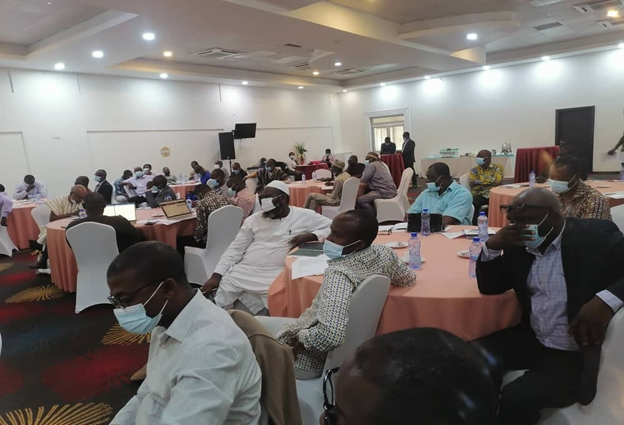
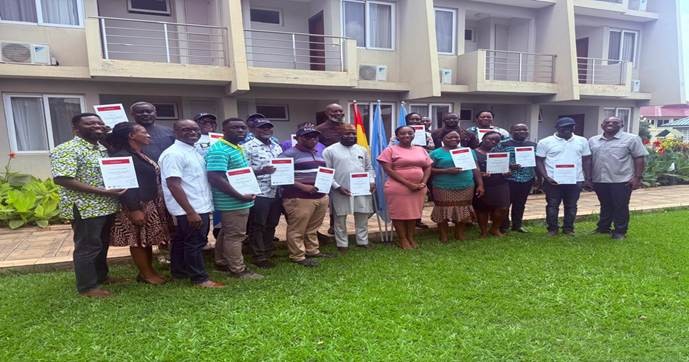
- Conduct SECAP Training of Trainers (ToT) workshop for 20 (males – 13, females – 7) project staff and key implementation partners such as Department of Feeder Roads (DFR), Environmental Protection Authority (EPA), Department of Agriculture, AAFORD project and APEX Bank.
- Development of Stakeholder Engagement Plan (SEP) and Framework to implement project Grievance Redress Mechanim (GRM)
- Conduct Environmental, Social and Climate screening for the 27.6 km feeder roads (Gadorkope–Gallon 2, Oseikrom–Konadu and Boankrase–Anhwiase Tokrom) in the Kwahu East and Kwahu Afram Plains South Districts, Eastern Region.
- Reviewed existing grievance redress structures in the 21 feeder road beneficary communities in Kwahu East and Kwahu Afram Plains South Districts, to develop a harmonized, culturally appropriate, and accessible GRM framework.
Component 2: Market Access and Value Chain Development
Progress focused on preparatory and analytical activities:
- Identification of priority value chains (maize, rice, soybean, shea, cashew, poultry) in five Eastern Region districts.
- Compilation of secondary data on MSMEs and rural institutions.
- Knowledge exchange with SNV on multi-stakeholder platform (MSP) formation and sustainability.
- Drafting and revision of TORs for value chain analysis and MSP strengthening, pending recruitment of the Senior Value Chain Specialist.
Component 3: Project Management and Policy Engagement
Substantial progress was recorded under Component 3:
- Full compliance with disbursement conditions and establishment of the Project Steering Committee, which approved the 2025 AWPB and procurement plan.
- Update and approval of the Project Implementation Manual (PIM) and Financial Administrative Manuals.
- Conduct of regional inception workshops in Northern, Upper West, and Savannah Regions (182 participants), informing the 2026 AWPB.
- Development and approval of the M&E Plan, alignment with the Feed Ghana Programme, and advancement of GIS-based MIS and baseline survey procurement.
- Upgrade of financial systems (iSCALA 2024) and recognition of GoG in-kind contributions.
This email address is being protected from spambots. You need JavaScript enabled to view it.