

 The Government of Ghana has set a target to achieve rice self-sufficiency by 2028, with a total paddy production target of 3.31 million metric tonnes.
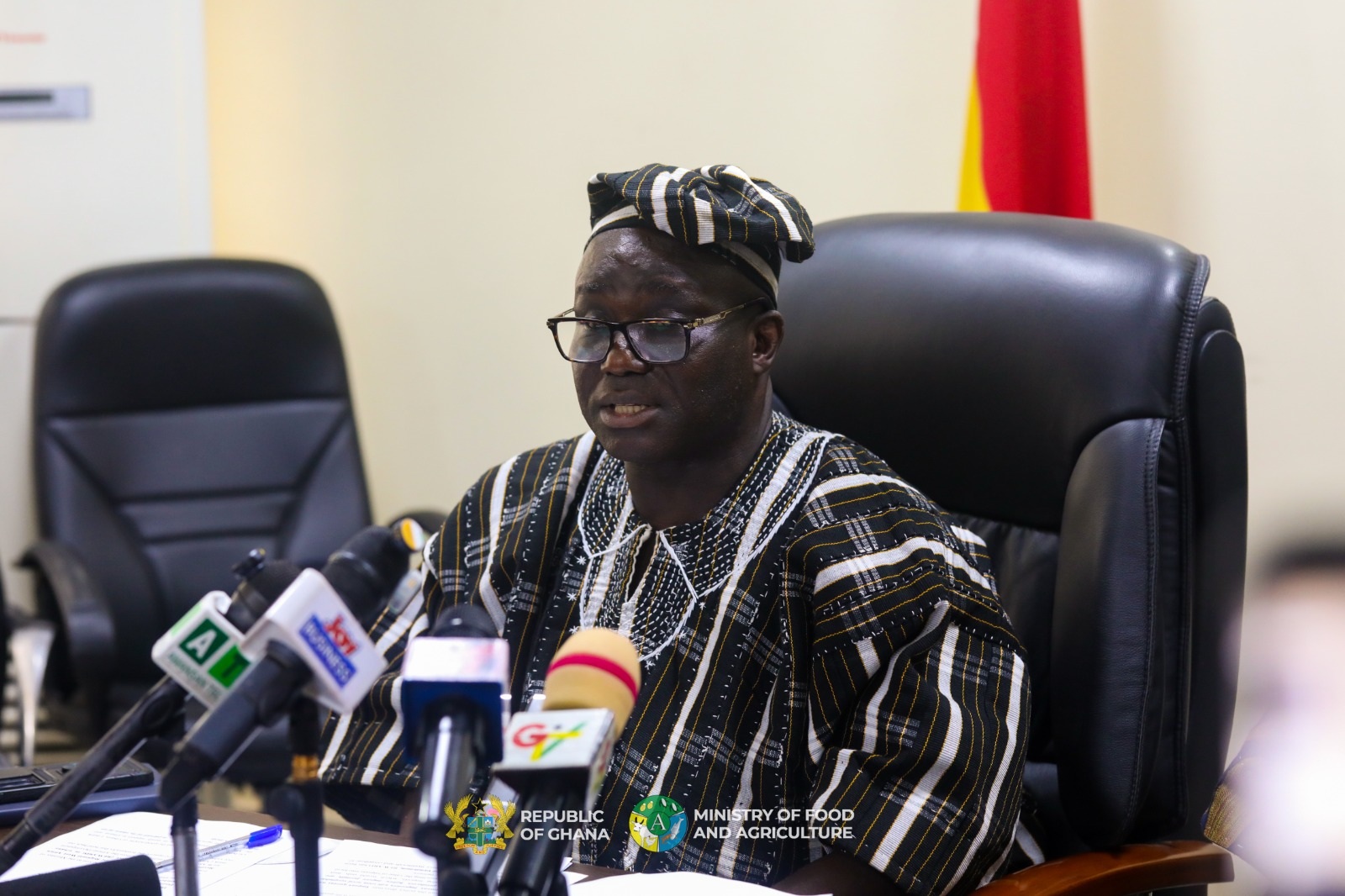
The Minister for Food and Agriculture, Hon. Eric Opoku, announced this on Wednesday, 7th October 2026, at a press briefing on the Regional West Africa Resilient Rice Value Chains Development (REWARD) Project held at the Ministry’s Conference Room in Accra.
The US$18.8 million grant from the African Development Bank (AfDB) is aimed at addressing key challenges across Ghana’s rice value chain and increasing local production.
The Minister noted that milled rice production had increased from about 650,000 tonnes to 900,000 tonnes in 2024 and 960,000 tonnes in 2025. However, local production currently meets only about 56 per cent of national demand, leaving a significant deficit that is met through imports.
Ghana spends an estimated US$320 million to US$500 million annually on rice imports. The Government therefore intends to close the production gap and retain more value within the local economy.
Describing REWARD as “Feed Ghana in action for rice,” Hon. Opoku said the project would develop 3,200 hectares for rice production in the Northern Savannah Ecological Zone, improve access to quality seed and mechanisation, and increase yields from 3.5 to 4.5 tonnes per hectare.
The project will also support selected seed centres, rice processors and 10 strategically located rice processing centres, while providing hermetic storage facilities to reduce post-harvest losses.
More than 20,000 smallholder farmers in Tamale Metropolitan, Mion, Savelugu, East Mamprusi, West Gonja, Bawku West, Wa Municipal, Sissala East and Nandom are expected to benefit directly from the project.
The Minister further announced that rice produced under the project would support the supply of quality locally produced rice to schools, prisons and other public institutions.
He also disclosed a new policy direction under which rice import quotas would be linked to local investment. Importers would soon be required to demonstrate verifiable partnerships with local producers before import permits are granted.
“We are not banning imports, which would only hurt consumers. Instead, we are channelling the value of imports into local production and empowering our farmers,” he said.
Hon. Opoku also expressed appreciation to the Government of Japan for a ¥394 million grant, equivalent to about US$2.49 million, under the Japanese CARD Grant Aid Project – Enhancement of Rice Seeds Production Capacity.
The grant will provide combine harvesters, trucks, seed cleaning machines, maintenance tools, high-pressure cleaners, transformers and a vehicle for monitoring and supervision.
The equipment is expected to arrive in November 2026 and will support efforts to improve seed production, mechanisation and the quality of locally produced rice.
The Minister said the grant also includes training for value chain actors to strengthen quality and competitiveness.
The Ministry, in consultation with the AfDB, plans to formally launch the REWARD Project in the first week of November 2026, ahead of the 2027 production season.
He urged beneficiaries, particularly farmers, to embrace the interventions and ensure that all resources provided are used for their intended purposes.
Hon. Opoku expressed appreciation to the African Development Bank, the Government of Japan and other partners for their support towards strengthening Ghana’s rice value chain and advancing food and nutrition security.